Saturday, July 9, 2022

You Don't Have to Disclose Your Illness at Work

            For the past year and a half since I started graduate school, I’ve debated disclosing my chronic illnesses to my advisor. When I interviewed, I explained that I’d had a chronic illness in the past (since we discussed my leave of absence from college), but I didn’t say anything about current conditions. I planned to do it when I started the program, but then I started virtually so I told myself I’d do it when I met him in person. And once we met in person, I wanted to wait until the field season had started because I wanted him to see me as a person before he learned about my illnesses. I realize that this is a major privilege of having my invisible illnesses, that I can choose if/when to discuss them.

            Then, a few months ago, I started to become really sick again in a way that frequently interfered with my work. I stopped going to classes in person (luckily they all had a virtual option), and I found myself canceling meetings frequently and falling behind on work. When it first started, I assumed it was a virus or temporary illness, so I didn’t even consider telling my boss anything besides the fact that I “was sick”.

            However, after a few weeks I started to recognize symptoms that I’d had with previous illnesses, and some symptoms weren’t going away. I still don’t know what’s causing them, but at this point it’s most likely a combination of chronic illnesses I’ve dealt with before and possibly new conditions.

            During the summer, instead of taking classes I work full-time as a research assistant to my advisor. The first few weeks of this summer were hard- I found myself struggling through every work day, still calling in sick several days a week, and too sick to do anything on the weekends. Every time I told him that I was too sick to work I debated if I should tell him anything else or talk with him more about what was going on.

            I spent hours reading articles on The Mighty, blogs, and other websites about discussing chronic illnesses with your boss. Every article had a different suggestion: some said never ever disclose your diagnosis with your boss, and only talk generally about it when you need accommodations. Others advised being up front about your diagnosis and how it could affect your work in the future. Out of everything I read, there seemed to be two conclusions: 1) it depends on you, the specifics of your medical and work situations, and your relationship with your boss and 2) you legally don’t have to disclose anything, so you should only do it if you’re comfortable with it.

            Eventually, I decided that I would tell him some of what was going on, as an explanation for why I’ve missed so much work and to ask for more flexible hours in the future. I didn’t particularly care if he knew about my medical conditions, but it did feel sort of strange because he doesn’t know much about my personal life.

            The next day, when our plans for the day got cancelled, I asked if I could meet with him. When we sat down, he asked if we could talk about my health, and I said yes. When he asked how I was doing, I said okay. Even though I’d planned to, I didn’t say anything more specific, and he didn’t ask.

            Instead, he told me that I could take as much time off as I thought would be helpful. He said I could work half days, or take a few days or even a week off if that would help. And he explained that it was okay if we missed some of my research plans for the summer, that it didn’t matter compared to my health. Finally, he asked if there was anything else he could do to help me.

            I’m so grateful of his response. I’m grateful that he was so supportive of me. That even though I felt like I was asking a lot by asking to shorten my work day, he never made it feel like I was causing a problem.

            I was shocked that he could be so supportive and offer so many helpful suggestions even though I didn’t disclose my illness.

            In everything I read, it seemed like the only way to be supported by your employer was to disclose your illness. Even if you didn’t name your conditions, it seemed like you had to describe somewhat how it affects you and your work. And I’m sure that can be extremely helpful, especially if your boss is unsure how to support you. However, in this moment, I wasn’t ready to do that.

            In the future, I might decide to talk more about my health conditions with my boss. If symptoms change how they affect me at work, maybe that will be a conversation. Or maybe I’ll just decide that I would like to talk to him about it.

            But I now realize that the choice to disclose your illness should not affect how you’re treated and if you’re supported. You should not disclose it because you feel like you owe someone an explanation, or because you feel pressured into it.

            I’m glad I didn’t discuss it in more detail with him, because I clearly wasn’t ready. I thought I had to be ready, and I thought the fact that I had read about it, thought about how I’d bring it up, and planned what to say meant that I was ready. But it didn’t: I still felt uncomfortable about it, and I realized that it wasn’t just because I was nervous about having the conversation, it was because I was still sort of uncomfortable about how it would affect our relationship.

            I hope you find people who are as supportive as I did. If your boss isn’t, talk to Human Resources or find someone else at your work to help you. And I hope that if you decide to talk about your illness, you do it because you want to, not because you feel as if you owe anybody an explanation.  


Friday, July 8, 2022

The Strengths of Living With Chronic Illnesses


“Courage doesn’t always roar. Sometimes it’s the quiet voice in the night saying we’ll try again tomorrow.” ~Mary Anne Radmacher

 This week has been challenging. A year ago, I would never have imagined that I could handle such a thing. But honestly, it hasn’t been the hardest week this year.

I keep seeing posts on Instagram about strength: about building mental strength to focus better and push yourself at work. About people building physical strength with big lifting goals or by training for longer road races.

And obviously, those are incredible strengths. But there are other types of strength that we don’t talk about. Those are the strengths I’ve used this week. The strength to ask for time off work even though I’ve missed a lot of work recently. The strength to give yourself time to rest. The strength to do a painful medical test that you know will make you sick because you need the answers it might give. The strength to get up every morning, even though you’re exhausted and in pain. The strength to decide that even if today was miserable, I will go to bed hoping that tomorrow is a new day.

I had two tests done yesterday: a colonoscopy and endoscopy. I was terrified for both of them: the endoscopy because I was traumatized by the same test when I was seven years old, and the colonoscopy because I’ve heard that it’s terrible. My whole life, I’ve been terrified of vomiting, and during the preparation I vomited 12 times.

But there were other parts of this week that were challenging. I had to talk to my boss over the long weekend to ask him if I could miss half of the work week to do these procedures that needed to be done this week. I had to ask a new coworker to drive me to these appointments because my other friends can’t drive. I had to manage the scheduling, pre-op, and post-op care for myself since I live alone and my family couldn’t come to help me.

These aren’t the types of challenges and skills that you can post about on social media. These aren’t things I can tell my friends about. But they’re my reality. And I’m proud of myself for being strong enough to do them.  

When we think about invisible illnesses, we often think about the challenges, the struggles that people don’t see. But that’s not the only thing people don’t see: they don’t see the strength that keeps us going everyday. They don’t see the determination that lets us put up with the many challenges. They don’t see the skills of self-advocacy we are forced to develop. They don’t see the strength it takes to resist the endless pressures of hustle culture.

 It’s not easy to talk about, most people who haven’t experienced chronic pain or illness can’t imagine what it’s like. When you think about a ‘typical’ sick day, it doesn’t seem like it’s about strength, it’s mostly about resting and recovering for the next day when you’re better. But with chronic illness, you never know if/when you’ll be better. Instead, you have to be strong enough to keep going anyway.

I first read this quote in Jessie Diggins’ “Brave Enough” (an incredible book that everyone should read). To me, it perfectly captures the strength we must have to live with chronic illness. Sometimes, we forget how strong we have to be. Sometimes, just choosing to keep living our lives is the hardest thing in the world. Even on my hardest days, this quote reminds me to keep going, and that sometimes, just that decision is everything.

Thursday, May 12, 2022

It can be hard and good

     Recently, one of my friends was complaining about our job. And I responded, yes, it’s hard, but I love it. And she was shocked. We often discuss challenges and frustrations about our job, and I feel like I’m usually overwhelmed by the amount of work that I still need to do. I realized that even though I also love it, I don’t always express that to her. Possibly because I know that she hates it and is considering quitting. Or because I assumed she saw the good parts too.

              It reminded me of a quote, “It can be hard, and it can be good.” When I worked as a farmer, this was my bosses’ motto. The summer is always the busiest season, and it means long, exhausting work days. But it’s also the best part of the year: everything is alive and there’s so many different types of fresh produce. Customers get excited about local produce, and suddenly the farmer’s market is so busy. It’s easy in those moments to get caught up in the hard: the being exhausted, stressed, or overwhelmed. But it’s also important to see the good, and to realize that they can exist together.

              As I’ve been thinking about this, I’ve realized how much it applies to my physical health. I’ve been dealing with worsening symptoms of my chronic illness, and it hasn't been fun. I realized I went to my doctor's office more often in the past two weeks than I went to work. But when I’m struggling with my health, it’s so easy to label days, weeks, or even years as “I was sick.” And yes, sometimes being sick is all consuming. But sometimes other things happen. Especially living with a chronic illness, you realize that life keeps going even when you’re sick.

              Looking back on the semester, I’m tempted to just think about the fact that “I was sick”. I spent so much time in bed, dealing with doctors appointments, and generally just frustrated by how many things my health was preventing me from doing. But I’m trying to remember that even when it’s hard, it can also be good.

              A few days ago I was on campus all day (a rare thing for me anyway, and never happens when I’m sick), because I had meetings and classes. During that day, and looking back at that day, it was easy to get in my head about how stressful that was for me. How I had to wake up early because I wasn’t sure I could eat breakfast. How I sat at lunch with my friends and could barely eat because the idea of food made me so nauseous. How I ended up going to take a nap in my car after lunch because I realized I was too tired to focus on anything, and I woke up to texts from my friends who had worked together to finish a homework assignment I still needed to do.

              But it wasn’t all hard. There were so many good moments also- walking with my friends back from class, laughing about our professor and how all his examples involved either cows or rabbits. The fact that I had meetings in person, which I hadn’t had in the two years since I’ve started this job. The flowers blooming on the trees across campus because it’s finally spring. And the fact that I knew myself well enough to take a nap so that I could be awake for my last class of the day. Knowing that even though I felt terrible for most of it, I still went to classes and meetings, I still learned and participated.

Close up picture of white and pink magnolia flowers. Background shows the rest of the tree, in front of a brick building
Some of the beautiful flowers on campus

              I’m not saying we need to be positive all the time.  There were absolutely days, even weeks, when I was too sick to get out of bed, and I can’t list a single positive thing about that. Which I think is 100% okay. And there were days when I felt physically fine, yet I wouldn’t describe them as “good days”.

              But I do believe that it’s easy to be busy or overwhelmed or not feel great, and to believe that that’s the only thing going on. I think it can be powerful to realize, that yes, it is hard, but it can also be good.

Tuesday, May 10, 2022

Starting Over

               “Don't be afraid to start over. This time you’re not starting from scratch, you’re starting from experience.”- Unknown

              This quote has been everything to me lately. I’ve been sick for the past six weeks, and I don’t know if it’s a flare-up of other chronic illnesses or if it’s something new. But it’s been reminding me of things that I thought I was long past.

              It’s reminded me of the fear of not knowing what will happen next. Being terrified that my body will never recover. Not knowing what new symptoms I’ll start experiencing next, or how they’ll affect my life.

              It brings back memories of endless doctors' appointments. The unclear lab results. The disappointment when tests come back normal. The being dismissed by doctors, until suddenly they call you in a panic when things are more serious than they realized. Long wait times to see specialists who often didn’t have any answers. Endless tests that come back with inconclusive results. Being sent to the ER for mentioning certain symptoms. The new medications with different side effects every time.

              It’s terrifying to think that my illness might have come back. Last time I felt like it destroyed my life. It took away everything I considered my identity: my school, my hobbies, my friends. It took me 2 years to be able to work again, even part time. It took me even longer to learn to trust my body again.

              I wasn’t sure how I could go through that again. The depth of depression it caused. Am I strong enough to go through that again? I don’t know. Managing not just the physical symptoms, but the fear and other emotions, and working with doctors to get answers. How can I do it all again?  I’m also balancing a lot more in my life right now than I was last time it happened, will this all fall apart? Will the life I’ve struggled to rebuild come crashing down again?

              Last time, I was relatively near my hometown, near the doctors. But this time I’m halfway across the country. I’ve had to find new doctors for everything. In a small town, there are not the specialists I worked with before, the doctors who specialize in my conditions and teach at the country’s best medical schools.

              But what I do know is this. I’m not starting over. I am starting from experience. I am afraid, but I can use what I learned last time to help. These are the things I’m doing now, my non-negotiables:

  •         I am only working with doctors who respect me and listen to me. I don’t care if they have all the qualifications in the world, if they’ve literally written books on my condition. If they don’t even act like they care about me, it’s not worth my time.
  •         I am finding doctors who will advocate for me. Last time I didn’t have a good PCP, so every doctor sent me to different ones, in an endless cycle of referrals. Now, I have an excellent PCP, but he’s halfway across the country and can’t even treat me virtually due to licensing restrictions. But I saw a few different doctors at my school’s health center, and the one I trusted I have made my new PCP.
  •         I am preparing for appointments. I get nervous when I meet new doctors, and in the past that has resulted in me barely saying anything, which means I just leave the appointment frustrated by the lack of answers. This time, I’m making a plan before each new doctor I see, with an overview of symptoms, more detailed description of symptoms specific to them, questions for them, and a medication list. That way, when I walk into the appointment, I know exactly what I need to say before I leave.
  •         I am getting accommodations from work and school. Last time I didn’t do this, and when I approached my professors they were not accommodating. However, after I went through the formal accommodations process they were very helpful and supportive.
  •         I’m asking for support when I need it from my friends and family. Last time, I was ashamed to ask for help, and I felt like I was always being too lazy. Now, I know that the people who I need in my life will help and support me, and I’m not dealing with people who can’t.
  •         I’m being nice to myself. Last time, I judged myself constantly. Anytime I couldn’t do something I had previously agreed to do, I felt guilty. When I couldn’t finish things I used to be able to do, I felt broken and lazy. This time, I’m sure I will still feel those same feelings. But I will try not to judge myself for them. Because it isn’t easy being sick, and I am doing my best.
  •         I’m prioritizing my health. Instead of doing everything I can to stay on top of work and school, I am putting my health first. I am taking time to cook nutritious meals. I’m exercising when I can. I’m resting when I need to. 

A bright pink flower just starting to bloom. in the background, green grass
Sometimes starting over can be beautiful

It can be so scary to feel like you’re starting a chronic illness journey, whether it’s for the first time or the fifteenth time. If you’ve been through this before, what have you learned from your experience? Even when it feels impossible, you will get through this. I hope you’re able to find the support and help you need to make it easier for you.

Monday, May 9, 2022

Tips For When Food Makes You Nauseous

     For the past few weeks, I’ve been struggling with nausea. It’s never been a symptom I’ve had long-term before, and it hasn’t been easy getting used to it. I’ve been leaving classes early because I’m afraid of getting sick in class. I’ve avoided eating with other people, or even being around people who are eating. I study vegetable production, and until this started I never realized how much we talk about vegetables. In the class I TA for, the Professor spend a lecture discussing winter squash, and I had to leave when he started naming different squashes. No pictures, no scents, just the thought of food. But one of the hardest things has been forcing myself to eat. 

    I love food, I always have. I love cooking and baking, but mostly I love it because I love eating good food. I choose my career because I want to help more people have access to high-quality food. But lately, nothing is more disgusting than the idea of eating. 

 Here are some tips that I’ve found helpful for eating when you’re constantly nauseous: (note these aren’t for if you’re struggling with vomiting or other problems, but for ongoing nausea with no known cause): 

1. Talk to your doctor. Nausea can be a symptom of many illnesses, and like any new symptom, it’s important to get it evaluated by a doctor, especially if it lasts longer than a few days.

2. Take medication if your doctor will prescribe it. The first time I saw a doctor for this, they didn’t offer medication. Three weeks later, when I saw a new doctor, he offered it and I immediately said I’d try it. It doesn’t fix the nausea, but it does make it go away sometimes when I need it to, and it makes it easier to eat. There are also over the counter medications you can try. 

3. Cook foods that you normally like. Often when I’m sick, I find myself avoiding my favorite foods because I don’t want to associate them with feeling sick. But when you can’t stand the thought of any food, sometimes it can help to remind yourself that this is something you do enjoy, even if it doesn’t seem like it right now. 

4. Eat foods that you know won’t irritate your stomach. For me, this means a lot of rice and toast. After a few weeks, I’ve added in vegetables and protein, but I eat the same foods several days in a row once I know I can trust it. I don’t want to eat anything that will make me sicker than I already am. 5. Eat foods that don’t require a lot of cooking. For me, one of the hardest things is walking into the kitchen and forcing myself to cook when I can’t stand the thought of food. It’s much easier to tell myself that I need to eat, then go and grab something from the fridge that’s already cooked and ready to eat. The less time I have to think about food, or smell food, before I eat, the better. I’ve found that minute rice, frozen vegetables, or frozen pre-cooked meals are helpful for this. 

6. If you have to cook, don’t do it right before you eat. If I plan to eat pasta, or something else for dinner that requires some cooking, I’ll do it earlier in the day. That way, if cooking makes me feel worse, I don’t have to then also force myself to eat. 

7. Distract yourself. Usually I try not to read or watch TV while I eat, and instead focus on the food I’m eating. However, when you don’t feel well, the last thing that you want to do is remind yourself that you’re eating. I watch my favorite TV show, listen to a podcast, eat outside, or read a book every time I eat so that I have something else to focus on. 
Picture of a tree with white flowers, in the background is a building and the blue sky. Grass and a sidewalk in front
Eating outside can help distract you while you eat

8. Make sure you’re staying hydrated. Nausea can often be caused or made worse by dehydration, so it’s important to make sure you’re drinking a lot of water, and sports drinks or some source of electrolytes. 

9. Try eating smaller meals throughout the day. Especially if you’re having trouble with an upset stomach, it can help to only eat small amounts at a time. Personally, I haven’t found that this works well for me, but it’s definitely worth trying. 

10. Don’t eat in places with a strong smell. If you can avoid it, try not to eat in places with strong scents, like many restaurants or cafeterias. It can be a lot easier to eat if you’re not already overwhelmed from the smell of food. 

11. Be honest with people you trust. When my friends asked why I wasn’t going to a lunch meeting, I told them that I would be sick if I had to see anyone else eat food. Which was true. I obviously didn’t tell everyone at the meeting that, but it can be helpful to let your friends know what’s going on. That way, if more things come up that you need to say no to, they can understand and will help you find alternatives. 

12. Exercise. It can be hard to exercise when you’re sick, and especially if you haven’t been eating a lot you should be careful. But even going for a five minute walk outside can make you feel better, and might even make you feel hungry. 

    I hope you found some of these tips helpful. What else have you found that works well for dealing with nausea?   

Thursday, April 21, 2022

Coronavirus Projects: Composting


Like a lot of people, this time of social distancing has made me want to take on new projects. My favorite coronavirus project that I’ve seen is starting a garden. With grocery stores sold out of food and posing a high risk of contracting the virus, it’s no wonder people want alternative ways to get food. And people are finally stuck at home, looking for things to do without leaving their yard, so gardening is a perfect opportunity. For those of you who don’t have space (or interest or energy or time) to make a garden, I would suggest signing up for a CSA at a local farm to support local farmers and get food without going to the grocery store.

But my family decided to do a slightly different project. We already had a garden started, but we still wanted to do something environmentally friendly. So we decided to focus on composting. We’ve had a compost bin for many years, but mostly we just bring out vegetable scraps once a week and forget about it. While this reduces food waste, it misses the main benefits of compost: converting this food waste into nutritionally dense soil to feed new plants.
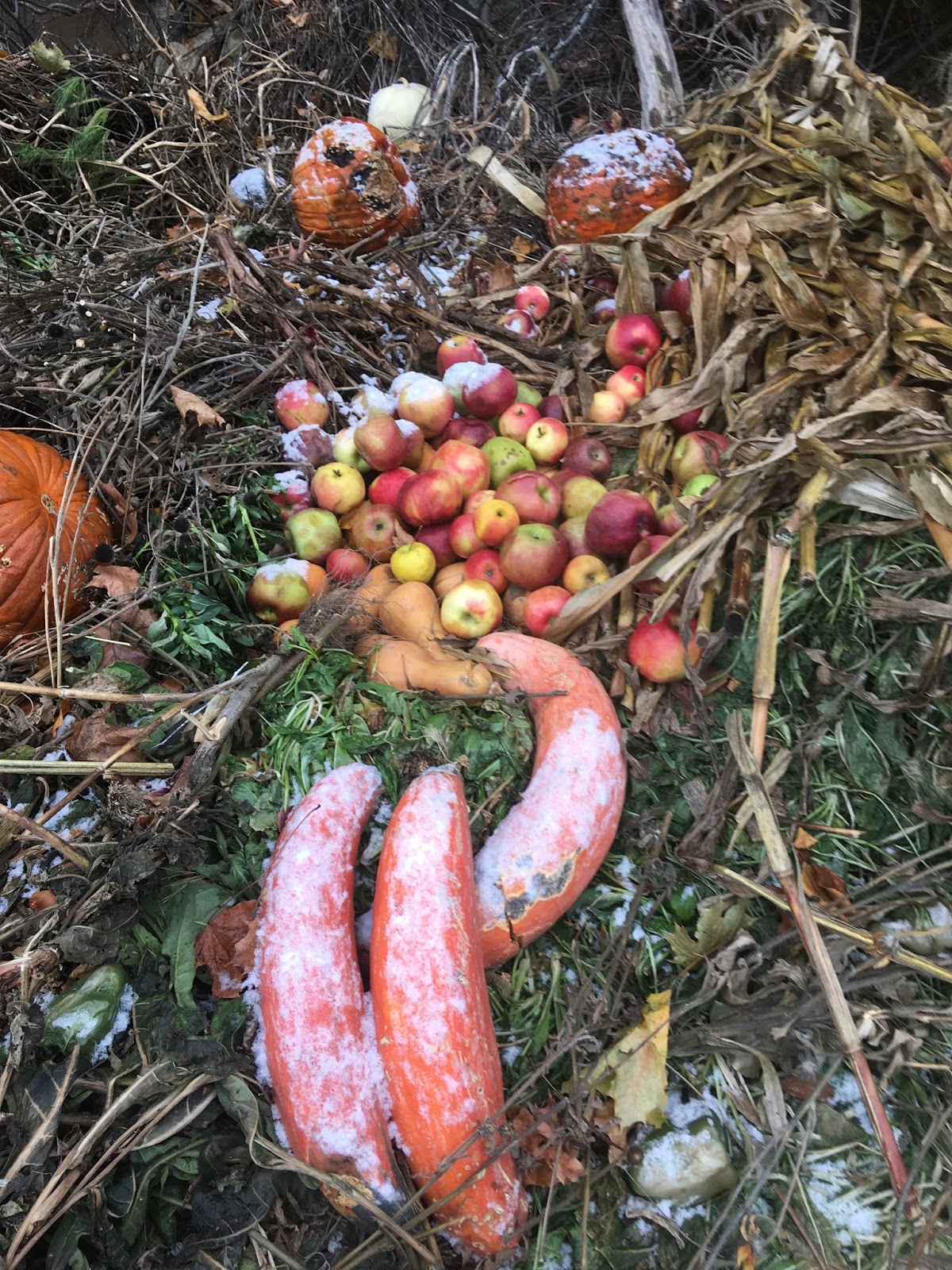
Frozen vegetables in a compost pile at the farm I work at...not decomposing now

So, we decided to make compost a priority. We added piles of wood chips from recent tree work we had had done, as well as dried leaves, because our compost was too high in “green matter” (vegetables), and it is supposed to be 50/50 green matter with brown matter (leaves, grass clippings, wood chips, shredded newspaper, etc.). I filled a bucket of brown matter and left it next to our compost bin, so that now every time somebody dumps in one bucket of vegetables they also will dump in one bucket of brown matter.

Secondly, we decided to make stirring the compost a regular task. Nobody wanted to do it before, because the compost is behind our garage and sort of annoying to get to. So we moved our compost out to next to the house, so that it will get more sun and be more accessible. If you don’t stir your compost, the food isn’t exposed to oxygen, so the microbes in your compost won't be able to break it down. But, if you mix the compost regularly, and thus expose it to oxygen, it will break down aerobically, so it won’t smell as much.

It’s not hard to set up a compost pile or bin: put a bin or start a pile outside and keep a small bucket inside (we keep it in a cabinet under the kitchen sink-make sure it has a lid to prevent odor) for collecting food scraps. Collect vegetable scraps, anything not cooked and that doesn’t have fat or oil. Then, once a week (or more or less often depending on how much you use), bring it outside to your bigger pile. And, don’t forget to do the work to maintain it: add brown matter, and stir it at least once a week.

In two months, you will have highly nutrient dense soil!


To learn more about composting read, check out these links:

Monday, April 18, 2022

What I Wish I Could Tell My Boss About My Undiagnosed Illness

     I’m sorry I haven’t been honest with you about my health. I know that you’re trying to support me, you’re trying to help, and I really appreciate that. I don’t know what to tell you. I wish there were ways you could help, but I’m not sure there are.

At this point, I don’t know what’s wrong with me. I don’t know if this is something that can be easily fixed with medication or another treatment.

I don’t know when I’ll have answers for you. Yes, I could tell you any of the previous diagnoses which were used to explain some of these symptoms when they’ve happened before, but I don’t know how much that would help. You shouldn’t need a name of an illness to be ready to help me. I don’t know if I’ll spend my next few days or weeks seeing doctors and specialists to get answers. I’ve done that before. I have many specialists I’m more comfortable with at home, but that’s halfway across the country. I have already been to two doctors this time, and they don’t have answers.

I don’t know how long this will last. I might be better in a week, or this might be something we’re dealing with for the rest of my time here. I know that doesn’t make it easy. It's one thing to reschedule a meeting if I might feel better next week, its much harder to do when I don’t know when I’ll be able to go to the meeting.

I don’t want to have to prove to you how sick I am, but I will if I need to. Last time this happened, after three months of trying to get a diagnosis so I could get help from my professors, my doctor diagnosed me with a concussion. We both knew I never hit my head, but we also knew that I needed time if I had any chance of finishing the semester, and a concussion covered some of my symptoms, and we hoped would give me time to recover. I don’t want to go through any of that process again. This time, I do have formal academic accommodations because of my chronic illnesses, but I hope that I don’t have to use them. You say that you want to be supportive, and I hope that’s true. We can involve the administration if we have to, but it's so much less work if we don’t.

I appreciate when you ask questions, when you offer to help. Sometimes even just telling someone that I’m not doing okay can be endlessly helpful. But sometimes I’m not ready to do that. And I really appreciate that you accept when I don’t have answers.

I need you to know that I’m scared. It’s terrifying to get out of bed and not know if you’ll faint before you get to the kitchen. It’s terrible having pain that you don’t know if or when it’ll go away. So yes, I might seem distant or distracted during our meetings. I might not care about some things as much as I used to. But I’m trying. I love my job, I love working with plants everyday. But that doesn't mean I'm always healthy enough to do it.

Some of the beautiful plants I work with

I know answers would be helpful, and believe me, I feel the same way. I just don’t know yet. In the meantime, time and space and patience would be the most helpful things you could do. I need time to rest, time to see the doctors I want to see, time to learn what works for me. I need space to experiment with different treatments. And I need patience. I still want to work on my projects as much as I can. I still want to plan regular meetings because there are things we need to discuss. But I might have to cancel them last minute, and I might show up unprepared. This semester might not look how you imagined it would, but I will do my best to finish what needs to be done.