Monday, April 18, 2022

What I Wish I Could Tell My Boss About My Undiagnosed Illness

     I’m sorry I haven’t been honest with you about my health. I know that you’re trying to support me, you’re trying to help, and I really appreciate that. I don’t know what to tell you. I wish there were ways you could help, but I’m not sure there are.

At this point, I don’t know what’s wrong with me. I don’t know if this is something that can be easily fixed with medication or another treatment.

I don’t know when I’ll have answers for you. Yes, I could tell you any of the previous diagnoses which were used to explain some of these symptoms when they’ve happened before, but I don’t know how much that would help. You shouldn’t need a name of an illness to be ready to help me. I don’t know if I’ll spend my next few days or weeks seeing doctors and specialists to get answers. I’ve done that before. I have many specialists I’m more comfortable with at home, but that’s halfway across the country. I have already been to two doctors this time, and they don’t have answers.

I don’t know how long this will last. I might be better in a week, or this might be something we’re dealing with for the rest of my time here. I know that doesn’t make it easy. It's one thing to reschedule a meeting if I might feel better next week, its much harder to do when I don’t know when I’ll be able to go to the meeting.

I don’t want to have to prove to you how sick I am, but I will if I need to. Last time this happened, after three months of trying to get a diagnosis so I could get help from my professors, my doctor diagnosed me with a concussion. We both knew I never hit my head, but we also knew that I needed time if I had any chance of finishing the semester, and a concussion covered some of my symptoms, and we hoped would give me time to recover. I don’t want to go through any of that process again. This time, I do have formal academic accommodations because of my chronic illnesses, but I hope that I don’t have to use them. You say that you want to be supportive, and I hope that’s true. We can involve the administration if we have to, but it's so much less work if we don’t.

I appreciate when you ask questions, when you offer to help. Sometimes even just telling someone that I’m not doing okay can be endlessly helpful. But sometimes I’m not ready to do that. And I really appreciate that you accept when I don’t have answers.

I need you to know that I’m scared. It’s terrifying to get out of bed and not know if you’ll faint before you get to the kitchen. It’s terrible having pain that you don’t know if or when it’ll go away. So yes, I might seem distant or distracted during our meetings. I might not care about some things as much as I used to. But I’m trying. I love my job, I love working with plants everyday. But that doesn't mean I'm always healthy enough to do it.

Some of the beautiful plants I work with

I know answers would be helpful, and believe me, I feel the same way. I just don’t know yet. In the meantime, time and space and patience would be the most helpful things you could do. I need time to rest, time to see the doctors I want to see, time to learn what works for me. I need space to experiment with different treatments. And I need patience. I still want to work on my projects as much as I can. I still want to plan regular meetings because there are things we need to discuss. But I might have to cancel them last minute, and I might show up unprepared. This semester might not look how you imagined it would, but I will do my best to finish what needs to be done.


Wednesday, March 9, 2022

When You Wish Your Pain Was Visible

    In the invisible illness and mental illness worlds, I often hear that it would be so much easier if this was an obvious physical injury. I’ve often felt the same way: if only the doctors could see the cause of my pain, then maybe they would believe me. Maybe my friends and family, coworkers would be more supportive. People can’t ignore a broken leg or an arm in a cast. 

    Recently, however, I’ve learned how misleading this can be. I hurt my ankle six months ago. I waited too long to see a doctor (mostly out of fear of not being believed), but when I did, an MRI showed that I had torn several ligaments in my ankle. Obviously, I hoped that this would lead to a clear and quick solution. After six months of pain with every step, I was eager to spend a few weeks on crutches and get better. But unfortunately, that wasn’t what I had to do. Even though I had been in physical therapy for months, the only suggestion the doctor had was to keep doing everything, and it would heal with time. When I asked if taking a break from running would help (sense it was always so much more painful after running), he replied, “No, definitely don’t do that. Keep running. Keep doing everything.” 

    It’s been hard. It’s reassuring to know that what I’m doing isn’t making it worse. But it isn’t easy to come home and go for a run after my ankle hurts so much just from walking around all day. 
    
    Throughout this process, it has reminded me of previous experiences with chronic mental and physical illnesses. When I was dealing with chronic pain and fatigue, and I just wished the doctors could see the problem. I wished they could see something wrong, and I wished it would help them understand and have ideas for treatment. But sometimes seeing a problem doesn’t lead to treatments. Sometimes, even when there is a clear issue, even when they can see your pain, they can’t do anything. In these situations, whether they’re from chronic illness or sudden injuries, I think there are two important things for us to do: find support and keep doing the small things. 

    Finding support is the most important thing to do in these situations. Support can come from doctors-maybe it’s the physical therapist who pushes you harder every week, but encourages you along the way. Maybe it’s the primary care doctor who asks you to keep checking in with him, even though your conditions are being treated by specialists. But we can’t rely on doctors to be our support systems, we need to build our own. Family and friends can be the best support systems. Some of my friends don’t even know what’s been going on (either with my recent injuries or my chronic illness), but I can still turn to them when I need a distraction from thinking about these problems. Then there are my friends who I can call anytime and complain about a doctors appointment or a hard day, and I know they’ll always listen and support me. Obviously, every friend can’t play that role, but I encourage you to find at least someone who can. Maybe it’s someone you know who has recently recovered from a similar issue. Or someone from a support group, or even a therapist. I think it’s important to have many different people to support you, and at least some of them need to be people you can talk to about anything. 

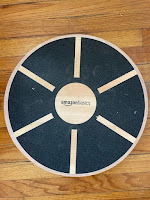
    The second most important thing to do in these situations is to do the ‘small’ things. Even when there’s nothing doctors can do to help, there’s usually ‘small’ things that are important for recovering. Sometimes these small things feel too small to make a difference, and other times they just feel overwhelming. But we have to keep trying. For my ankle injury, I try to do my physical therapy exercises daily, and stand on a balance board several times a day. I also ice it often, especially after doing any physical activity. For my mental health, the small steps are usually things like exercising, eating filling meals, and making sure I take my medication everyday. For my chronic illness, they’re things like sleeping, doing some type of movement, and seeing other people. Sometimes it’s hard to keep doing these things, because it feels like they don’t make a difference. But over time they do, and we need to keep trying.
A balance board, a wooden circlular board with black rough surfaces on a wood floor. Center of the board says "Amazon basics."
Balance board
    I think it can be easy to wish that our pain has a clear reason and a simple solution. But in the real world, that doesn’t always happen. In that case, I hope you’re able to find people to support you, and to keep doing the small steps to get better. It takes time, but it will be worth it.

Sunday, January 23, 2022

A Letter For Those Who Are Scared to Live Alone with Depression

Dear Annie,

I know that you’re terrified to live on your own with depression. I know that you don’t even feel capable of taking care of yourself. I know that you doubt your ability to cook food, your ability to do your laundry everyday, to get yourself to work.

I know you’re worried that there will be days that you will stay in bed all day and nobody will notice.

I know that you worry that nobody will notice if you’re not okay. That you could really be struggling, and even not be doing your job, and nobody would know. And it’s true. It is definitely possible that people might not notice if you’re not okay. But that is always true. But you can help them notice. Even though you live alone, you can make friends who you see regularly. And most importantly, be honest with people when you are struggling or need help. Even friends/family who don’t live nearby can be helpful if you just text them and let them know you’re struggling.

Here’s what you don’t know: a year from now, you will have lived on your own for a year, and it will have been one of the best years of your life. Yes, it will be hard. There will be days when you eat mac n’ cheese for dinner at 4pm. There will be nights when you stay up past midnight binge-watching shows because you don’t have any other plans. There will be days when you leave dishes in the sink. 

But there will also be many, many days and moments of your creation. Days when you get to decide how you spend your time. Days when you read your favorite books for hours, beautiful sunsets outside your windows, and moments when you abandon your plans to go play in the snow.

You don’t have to be perfect. You will do your best. And sometimes, you won’t even do your best, you will do enough. It might not look like the perfectly organized houses and meal-prepped lunches you see on Instagram, but it will work for you. 

One of the most exciting things about living alone is learning what matters to you. You will quickly learn when you need to eat, and you will learn how to cook the foods you need to eat. You will learn how to recognize when you won’t be able to cook dinner, and instead you will order out. You will learn that maybe you’re okay with leaving dishes in the sink overnight, but you like the counters clean. Maybe you’ll learn that you do your best work at 5 am and you’ll get up early everyday.

The plants that share my apartment

For some people, living alone doesn’t work for them. But it might work for you, don’t dismiss it because you’re scared. You will learn that you are stronger than you thought. That you are capable of doing what you need and want to do, and that its okay if you don’t do everything. I hope that you’re able to let go of some of your concerns and enjoy life on your own! 

Saturday, January 8, 2022

When My Therapist Gaslit Me Because of My Chronic Illness

I was gaslit by many people when I became sick with a chronic illness. Doctors told me I was making it up. Friends told me it couldn’t be that bad. Professors told me I wasn’t trying hard enough. The doctors were beyond frustrating. The fear I felt everytime I left their offices that I might have to live with this pain forever. And the feeling of being totally alone.

But the worst one for me was gaslighting by my therapist. After a while, I had become used to it from others, and it stopped surprising me. But I hadn’t been to therapy, so I had no idea what to expect. For a year and a half, I met with my therapist weekly. I thought that seeing her would help me deal with being sick. I thought at the very least it would prove to my doctors that I was working to improve my mental health. But what I didn’t expect was how completely it could harm me.

My therapist didn’t believe I had a chronic illness. When she first told me this, I was excited. And relieved. Maybe that would mean it wouldn’t last. I believed her when she told me that therapy could help improve my mental health and make me feel better.

But that isn’t what happened. Instead, week after week she would call me lazy and tell me I needed to work harder. She would tell me I wasn’t strong enough, that I clearly was too weak to handle anything real. That I didn’t belong at my college if I couldn’t keep up with the work.

At first, I knew she was wrong. But after weeks of this, I started to believe her. After all, she was the mental health expert. And more than anything, I wanted to believe her. By then, doctors had ruled out most other illnesses, so I was convinced it must be depression. I knew nothing about depression, so I was eager to believe that working harder could make me better.

So I did listen to her. I made myself sick staying up long after I was even functioning just to get work done. I would often walk into class crying from pain on the way there, but I told myself to get over it. When I was tempted to skip class, I reminded myself that I had to do it or I was too weak to be there. When I wanted to rest, I remembered her voice telling me that everyone is tired. When I thought about talking with friends about how I was struggling, I remembered that even medical professionals thought this was only because I wasn’t strong enough.

Once, I complained to her about how frustrating it was being home and struggling to help cook because my fingers hurt so much. I told her how much I feared becoming a burden to my family and the people I love. And she responded, “my four year old can cook dinner. He’s more helpful than you are.”

A blue cutting board showing large slices of butternut squash and some smaller slices that have been cut
Cutting vegetables- a painful task that I was shamed for struggling with

I went to a therapist in hopes of finding someone I could talk to about these challenges, a place where I could feel safe. A place where I wouldn’t be judged for talking about struggles that nobody else could see or understand.

But instead, I found myself being judged constantly. Anything I told her would be held against me. Instead of finding any type of healing, I found myself becoming more and more broken. I told her my fears and frustrations that this illness was ruining my life, and instead of reassuring me, she confirmed my fears, and told me that it absolutely was, and it was my fault. I felt hopelessly lonely. The one thing that could’ve helped me feel better wasn’t working, and I truly believed it was because I wasn’t working hard enough.

Perhaps worst of all, she made me feel ashamed of my illness. Like it was a personal fault of mine, and that not getting better was a personal weakness. She blamed me for not getting better fast enough.

Since then, I hesitate to talk about my illness. I started a new job a year ago, and I haven’t told my boss about my illness. Friends ask me why, and all I can think about is her voice. Confirming my fears that my illness is a weakness that I should be ashamed of, that people will think less of me because of my illness. When I think about asking for extra time on an assignment, or to change my schedule, I can’t help but feel that I just need to work harder.

I’ve told very few people about this experience. Mostly because therapy isn’t something we talk about. And because I truly believe most therapists are amazing and doing their best to help people. But sometimes, even well-intentioned therapists can end up hurting us. I’m grateful for many incredible doctors and therapists I’ve worked with, but I still think this is an important story to share. I wish that I had known that it was okay to see a different therapist. That deciding to not work with her didn’t mean I was giving up on getting better. I wish that I had believed myself no matter who doubted me. I hope that nobody else has to have such an experience. But if you do, try to remember it isn’t your fault. Remember that nobody else knows you better than you know yourself, and that there are always other options, other people who will support you.

Monday, November 8, 2021

Accessibility In Higher Education Needs to Go Beyond An Accommodations Statement

At my university, most Professors (although not all) have an accessibility statement in their syllabus. It usually outlines the process for getting accommodations in their class- getting them approved by the disability office and then discussing them with the professor early in the semester. I appreciate this statement because it tells students with disabilities the exact steps they need to take.

However, this statement does not go far enough. I, like many other students with disabilities I have spoken with, am worried about using my accommodations. I’m worried about discussing them with my professors because of fear of stigmatization. As a graduate student, my relationships with professors will be very important in my career, and I don’t want them to think that I’m less capable because of my disability.

This semester, I am taking a course where each week is taught by a different professor, so each professor gives and grades assignments. This means that to get accommodations in this class, I will need to tell all of the professors about my accommodations. And honestly, I’m terrified to do it. This is the first time I’ll be meeting most of the professors in my department, and I don’t want them to think less of me. Most of the conversations about accommodations I’ve had in the past were positive, but some were not. Throughout my five years in academia, I’ve had many professors suggest that I should not be in their class and that I might not be able to handle this career choice, because of my illness. 

Professors don’t understand that these accommodations don’t make me less capable of pursing this career. The symptoms that affect my ability to succeed in the classroom might have no effect on my performance at work. Beyond that, symptoms and treatments can change, so it’s possible in a few years after I graduate I will have different physical abilities than I currently do.

Luckily, many professors do understand these things and are supportive of students with disabilities. But in higher education, disabilities are not talked about. I have no way of knowing which professors will support me, and which professors will fight against the accommodations I’m requesting.

I should not have to worry that asking for accommodations will affect my standing in the classroom or within the department. I should not have to fear criticism from professors. I should not have to fight for accommodations the school has already approved. I should not have to wonder if the professors I’ve worked alongside for three months (and not told them) will look at me differently.

Professors need to step up. There needs to be more education for professors about disability accommodations. They need to be trained how to best support students, and they need to be taught that disabilities do not determine a student’s identity. They need to talk about accommodations at the beginning of the class, and be clear that they will support any university-approved accommodations.

Students with disabilities already bear a lot of the cost of dealing with this ableism- the accommodations process is often very complex and requires a lot of work from the student. However, I think that as much as we are able to, we need to continue to fight the ableism we see in academia. We need to advocate for our accommodations when professors doubt us. We need to be honest about our disabilities and how they affect our schoolwork. And if professors don’t listen, we need to hold them accountable and turn to the disability office or other people for support.

As we return to in-person school, I hope that we can make accessibility and ableism a part of the conversation. I hope that students with disabilities can feel both welcomed and supported in their environments, and I hope that all students and Professors will work to make that happen.


A picture of two trees, including a blooming cherry tree in front of an old brick building. A sidewalk between a grassy lawn leads to the building
Returning to campus

Tuesday, October 19, 2021

To the Doctor Who Helped Me Learn to Live With Chronic Pain

 Dear Doctor,

I still remember the first day we met. I was looking forward to the meeting, finally getting to see a “Pain Medicine Doctor”. I went into that meeting so optimistic: I hoped that you would finally have the answers I had been waiting for. A way to stop living in constant pain. A way to get back to living the life pain took away from me.

And to your credit, you did have some answers. No clear ‘magic bullet’, but you did suggest other tests I should have done, medications we could try, and other specialists who might be able to help. Most importantly, you assured me that you would help me, that you believed in my pain and you would work with me to make it better.

But I was also very disappointed. I had hoped that you would be able to take away the pain, but you made it clear that wasn’t possible. Over two years later, I still remember only one thing you told me. You had asked what I was doing before I got sick, and I explained how I had loved hiking with friends and farming. You told me “If two years from now you want to be hiking, you need to learn to hike with pain. I won’t be able to take away the pain, but I can help make it more manageable and I can teach you how to hike anyway.”

A picture of a trail through a forest. Ground is covered with golden leaves and it is very foggy.
I love hiking

Today, two years later, I am infinitely grateful for what you told me. First of all, it showed that you believed me. After being told so frequently that the pain was “all in my head”, this was a huge relief. It also showed that you understood the effect the pain was having on my life. Unlike some other doctors, you didn’t tell me that I should just “start running again” or pretend the pain wasn’t there. You didn’t blame me, and you didn’t make me feel like I was too weak to handle the pain.

Instead, you gave me hope. It took me a while to see it, because it wasn’t the hope that I was expecting. I had assumed a pain medicine doctor would get rid of pain, which you didn’t. But you did give me hope that I would be able to get my life back. You were honest, and didn’t pretend it would be easy, but you made it sound possible. At a time when I couldn’t see any future for myself, you showed me that one was still possible.

Not only did you give me hope, but you told me that you would help me get there. You told me that you would help me learn to manage the pain. You made living with pain a skill that could be learned, instead of an inherent trait that I thought I was too weak to handle. You made me believe that my life could get better. And unlike the many doctors before you who had been eager to pass me off, you assured me that you would help me along the way.

I’m writing this letter two years ago after an incredible weekend of hiking. During a 20 mile hike, I remembered what you had told me. And I realized that I am living a life I wouldn’t have believed is possible: working a job I love, in graduate school, and I get to go hiking. There are days when it is unbelievably challenging and when I am overwhelmed by the pain. But even with the pain, there are days when I am able to go hiking and do the things I love. And for that, I am infinitely grateful.

A photo looking out over a river. There's a few trees in the foreground that are losing their leaves for the fall. Then the river curving through fields and mountains. A sunny day.
From my hike last weekend

Thank you for everything you did to help me. Most of all, thank you for believing in me when I couldn’t. Thank you for reminding me that hope can take many forms, and for helping me build a life I love.

Monday, October 18, 2021

A Letter To Myself When I Have To Cancel Plans Because of Chronic Illness

Dear Annie,

 I know you debated for half an hour over how to phrase the text, but essentially the message was “I’m sorry, I won’t be able to come today because I’m sick.” It’s not a new message, because this isn’t a new occurrence. Yes, it felt different because it was a new friend. It felt scarier — you’ve never told them about your chronic illness, so they have no context to understand why you had to cancel the plans that seemed fine yesterday. 

 It’s hard because it feels like your fault. After all, you’re the one who told your friend that you couldn’t do it. But it’s not your fault. Being sick is not your fault, and the symptoms that come with it are not your fault. This is not something you signed up for, or something you ever would have chosen. 

 I know that it feels like you’re letting people down. I’m sure your friends are sad, because like you, they were probably looking forward to today. And it never feels good to be the one to take away that opportunity. But it isn’t you who decided not to go, it’s your illness. There was no way you could physically go, and you did the responsible thing by letting your friends know that as soon as you could. 

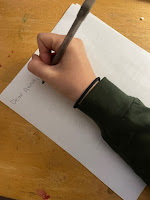
Large piece of paper with a woman's hand writing at the top. The first line is the only thing written, and it says "Dear Annie"
Writing this letter
It’s okay to feel sad because of what you know you’ll miss out on. I know it’s so easy to imagine your friends having fun without you while you’re homesick. And I know you were really hoping today would be different. But you will have another chance. 

 I know it feels like you canceled because you aren’t strong enough to push through it and go anyway. But canceling on them is not a weakness. You push yourself all the time to do things that you need to do even when it feels like too much. It’s never easy to say no, but you need to let your body rest. It definitely doesn’t feel like it right now, but you are doing what you need to do. And hopefully, good friends will support you as you prioritize your health. 

 I know it’s hard, but try to let this go. Take today to rest, and do what you need to do in order to take care of yourself. Hopefully, you will feel better soon and be able to spend more time with your friends.